Why a Tree Trunk Can Hold Several Tiny Habitats
Tree trunk habitats change with bark, height, exposure, and water flow; learn how these details shape where mosses and lichens settle.
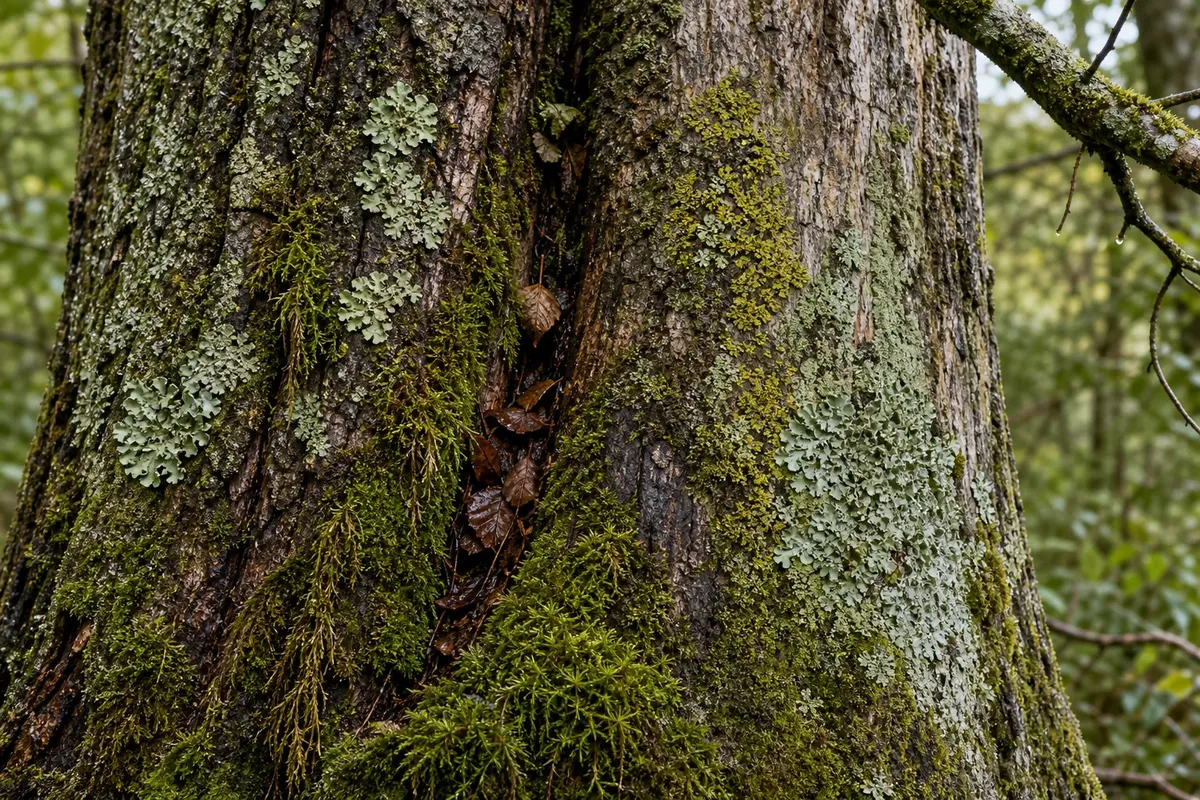
A tree trunk can support different mosses and lichens from its shaded base to its sunlit upper bark because conditions change across the surface. These tree trunk habitats are not separate rooms with neat borders. Bark, height, exposure, and moving water overlap, giving each patch a particular mix of shelter and stress.
What makes one trunk more than one habitat?
A habitat is the set of local conditions an organism encounters. On a trunk, those conditions can shift over a short distance. A sheltered groove may stay damp after rain, while a raised ridge dries sooner. A patch facing open sky receives different light and wind from one tucked behind a branch or on the tree’s lee side.
Mosses and lichens respond to these conditions in different ways, but neither grows according to a single rule. Moisture can favor some mosses, while tolerance of drying may matter more to others. Lichens also vary in their responses to light, water, and the surface beneath them. A visible patch records a combination of conditions over time, not a simple label such as “north side means moss.”
Look at the trunk as a mosaic, not as a uniform cylinder.
How does bark texture shape the available space?
Bark changes with tree species, age, weathering, and damage. Deep fissures can hold dust, fallen plant fragments, and moisture, while smooth bark offers fewer crevices. Ridges and plates also cast small shadows and interrupt the route water takes down the trunk. These details affect where spores, fragments, and other propagules can lodge, as well as how long a surface stays suitable after wet weather.
Texture is not simply a matter of “rough bark is better.” A deep crack may provide shelter but remain too dry, too exposed, or otherwise unsuitable for a particular organism. A smooth surface may still support growth where water lingers or where light and exposure are favorable. Bark chemistry and the tree’s own surface properties can matter too.
Compare a fissure with the ridge beside it; their conditions may differ even at the same height.
Why does height change the conditions?
The trunk’s base is often influenced by nearby soil, leaf litter, and low vegetation. These can shade the bark, reduce air movement, or keep the immediate surroundings humid. The base may also receive splash from rain or runoff. Higher up, the trunk is more exposed to wind and changing light, though branches can create pockets of shade and shelter.
Height does not create a fixed ladder of habitats. A low patch on a trunk beside a path may be more exposed than a higher patch under a dense canopy. The lean of the tree, nearby walls, neighboring trunks, and the direction of prevailing weather all alter the pattern. Branch junctions can redirect water and trap organic material, making them unlike nearby stretches of bare trunk.
Compare patches at similar heights on different sides before treating height as the explanation.
How do exposure and water movement interact?
Light, wind, and rain work together. A sunlit side can dry quickly, but a sheltered side may also stay dry if it receives little rain. Wind can remove moisture and increase exposure; a nearby branch or tree can blunt that effect. Rain does not fall evenly on every surface, and water reaching a trunk may run along ridges, collect in cracks, or be diverted by branch bases.
Water movement is especially easy to misread. A dark stain may mark a route used by runoff, but it does not by itself show how long the bark remains damp. A groove can channel water past one patch and toward another. On some trunks, a slight change in slope or bark form makes a noticeable difference to the route.
After rain, note where water appears to travel and where the surface seems protected from direct wetting.
Which clues help explain a patch on a trunk?
Does the north side always hold more moss?
No. Compass direction can influence sunlight, but canopy shade, local shelter, trunk angle, and rain exposure can override that broad pattern. Treat direction as one observation among several, not as an identification rule.
Can rough bark alone explain where growth appears?
No. Crevices may provide shelter and catch material, but texture works alongside moisture, light, and the properties of the bark itself. A rough section without suitable conditions may remain bare.
Why do patches stop at a sharp edge?
A boundary may follow a change in shade, water flow, bark texture, or exposure, but the visible edge does not reveal which factor mattered most. It can also reflect how the organism established and spread, so nearby surfaces need not be equally occupied.
Can a trunk patch identify a moss or lichen?
Habitat can help narrow what to examine, but it rarely identifies a species on its own. Growth form and other visible features matter, and some identifications require closer examination with suitable references or expert help.
How can you read the trunk without overclaiming?
Build an explanation from paired observations. Compare a groove with a ridge, a sheltered face with an exposed one, or the base with a higher section. Record what differs, then consider more than one possible cause. A field notebook can hold simple notes such as “deep fissure, under branch, damp after rain” without turning that observation into a claim about why a species is present.
Say you notice a moss patch in a crack on the shaded side of a tree. You note that the crack also catches leaf fragments and sits below a branch that redirects runoff. The expected useful result is not a certain explanation, but a clearer set of conditions to compare with nearby bare bark and other occupied patches.
Photographs can help preserve the pattern, especially if each image includes enough of the trunk to show height and nearby features. Avoid scraping or peeling growth to investigate it; observation from the surface is enough to ask sensible questions.
What the patchwork tells us
A trunk is a changing surface: bark creates small relief, height alters exposure, and water follows routes shaped by both. Mosses and lichens occupy that shifting arrangement according to their own traits and histories. Their distribution can therefore offer clues about local conditions, but it should not be treated as a diagram with one cause assigned to every patch.
For a useful tree trunk habitat note, include the side, relative height, bark texture, nearby shelter, and signs of water movement. Those details make a later comparison more informative than a record that says only “moss on bark.”