Crustose or Foliose Lichens: How to Read Their Growth Form
Learn how crustose or foliose lichens meet bark and stone, read their edges, and use growth form as a useful clue without mistaking it for an ID.
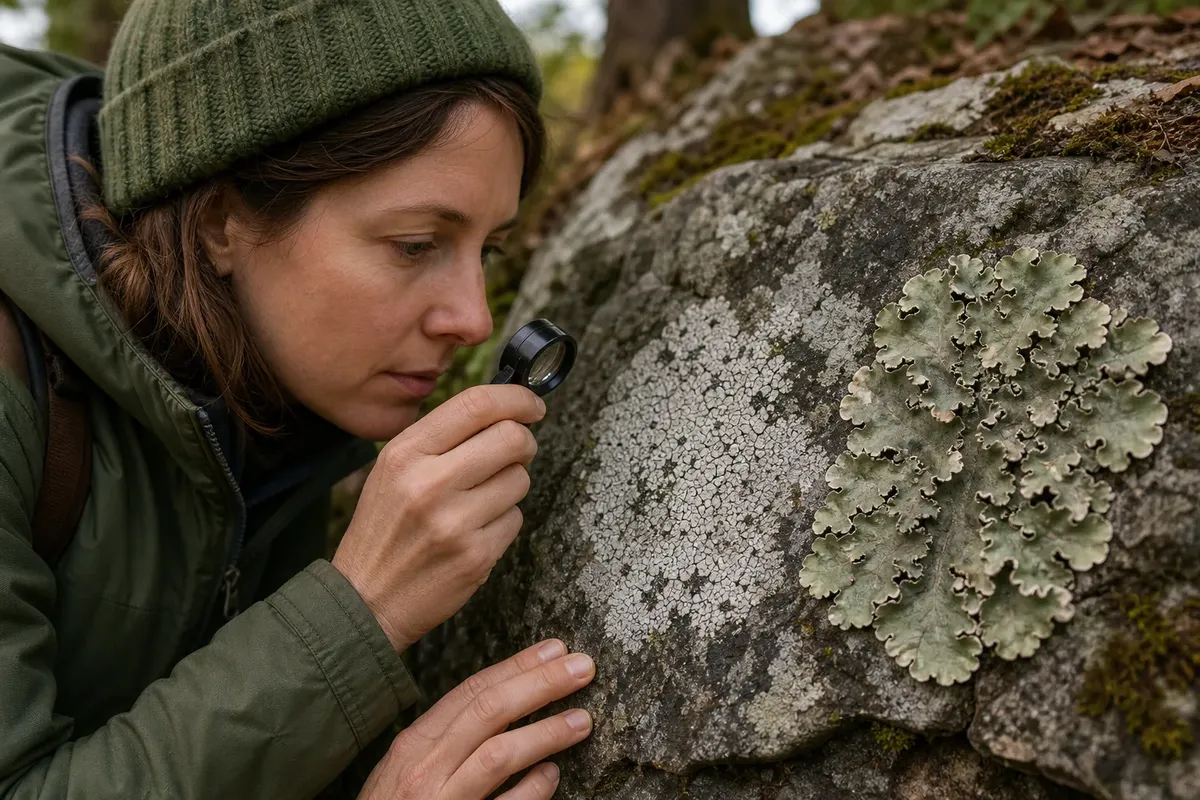
Crustose or foliose lichen growth form is easiest to read where the thallus meets its surface: one kind clings like a thin crust, while the other has flattened lobes with edges you can see. That distinction helps you describe what is present on bark, stone, or another substrate, but it does not identify a species by itself.
What does crustose or foliose mean?
Crustose and foliose are broad descriptions of a lichen’s thallus, the visible body formed by its fungal partner and photosynthetic partner. A crustose thallus adheres closely to the surface. A foliose thallus is leaflike, with flattened lobes that spread across the surface and usually have margins that can be distinguished from it.
The terms describe shape and attachment, not botanical kinship. Two lichens that look broadly alike may belong to different groups and differ in details that are easy to miss at a glance. Growth form is a useful first observation, not a species name in disguise.
Begin by asking how the thallus meets the substrate, not whether its color or outline resembles a familiar picture.
How does a crustose lichen meet a surface?
A crustose lichen is closely attached to its substrate, often across most or all of the visible thallus. It may look like a thin stain, a powdery film, a cracked coating, or a small collection of colored patches. The surface beneath it can appear to be part of the lichen, especially when the growth is pale and the rock is pale too.
That close attachment is the practical clue. A crustose lichen generally has no broad, leafy margins that lift cleanly away from the surface. Its border may be sharply drawn, ragged, or hard to separate visually from the substrate, but the thallus itself remains closely appressed.
On rock, crustose lichens can occupy tiny pits and irregularities, following the texture rather than forming a loose mat. On bark, the same general form may look like a colored patch laid directly over the outer surface. Some crustose lichens have conspicuous fruiting bodies, such as small disks, but those structures do not change the basic growth form.
Do not pry at a patch to see whether it comes away. The surface and the thallus can be damaged, and a close look with a hand lens is usually more informative than a forced edge.
What makes a foliose lichen look leaflike?
A foliose lichen has a flattened thallus divided into lobes. Its edges are usually visible as margins, and parts of the thallus may stand slightly away from the substrate. The lobes can overlap or spread outward, making the whole patch look like a small rosette, ruffle, or set of overlapping leaves.
Foliose does not mean that the lichen has true leaves, stems, or roots. The resemblance is about shape. The underside may differ in color or texture from the upper surface, and attachment can occur at particular points rather than across the entire lower face. Some foliose lichens are held by rootlike structures called rhizines; these are attachment structures, not roots that draw water from soil.
Look at several margins rather than judging from one curled corner. A lobe can lift because the surface is uneven, the thallus is old, or conditions have changed. The overall organization of flattened lobes is more telling than a single raised edge.
How can you tell the two forms apart in the field?
Use a non-contact inspection first. A hand lens helps reveal margins, cracks, and small structures without disturbing the lichen. A phone photo taken straight on and another at a shallow angle can make the relationship between thallus and substrate easier to see later.
- Look for margins: Distinct flattened lobes point toward a foliose form; a coating without obvious leaflike edges points toward a crustose form.
- Check the attachment pattern: Close adherence across the visible patch is characteristic of crustose growth; a foliose thallus may be attached at points while its lobes spread around them.
- Notice the outline: A cracked or granular patch can still be crustose. A scalloped, divided outline is more suggestive of foliose growth.
- Record the substrate: Note whether the lichen is on bark, exposed wood, stone, soil, or another surface, and describe the surface texture.
- Keep color in its place: Color is worth recording, but it can shift with moisture, light, age, and viewing conditions. Do not use it as the deciding clue.
Say you find a gray patch on a garden wall. In an imagined identification exercise, you photograph it from above and at an angle, then use a hand lens to look for raised lobes. If the patch remains a close-fitting coating with no clear leafy margins, you would describe it as crustose rather than call it a confirmed species.
Write what you can observe separately from what you infer. “Gray, cracked patch on shaded stone, closely attached” is more useful than a confident name built on one visual impression.
What can growth form tell you, and what can’t it confirm?
Growth form can narrow the kind of lichen you are looking at and give you a reliable vocabulary for comparing observations. It also helps separate a broad crustose appearance from a broad foliose one when you are using a field guide or comparing photographs.
It cannot, on its own, establish species identity, habitat preference, age, or health. Many lichen groups contain species with similar overall forms. A crustose lichen may vary in color and surface texture, while foliose species can differ in lobe shape, underside, attachment, and reproductive structures.
Identification may require several features considered together: the substrate, thallus color and texture, lobe details, reproductive structures, and sometimes chemical or microscopic examination. A field guide may also use terms such as “squamulose” for a form made of small scale-like units, or “fruticose” for a more branched, shrubby form. Those terms describe other broad patterns, not intermediate species labels.
When a label, guide, or local conservation rule determines what you should do, follow its stated instructions. For ordinary observation, a careful description is often more defensible than forcing a species-level identification.
Which clues are worth checking next?
Can a crustose lichen have a visible edge?
Yes. A crustose patch can have a clear border, but its thallus still lies closely against the substrate rather than forming broad, flattened lobes. A sharp outline alone does not make it foliose.
Can a foliose lichen be tightly attached?
Yes. Foliose lichens can be firmly attached at points or close to much of the surface while retaining distinct lobes and margins. Look for the leaflike organization of the thallus, not just how easy it seems to lift.
Does a cracked surface mean the lichen is crustose?
Not by itself. Cracks can appear in crustose thalli, but a foliose lichen may also have a rough or divided upper surface. The relevant question is whether the thallus forms flattened lobes with visible margins.
Can a photograph settle the identification?
A photograph can preserve useful details, especially if it shows both the full patch and a close view of its edges. It may not show underside features, subtle textures, or structures that an identification guide needs, so treat the image as evidence to compare rather than a verdict.
How should you describe an uncertain lichen?
Use a description that remains accurate even if your first guess changes. Record the broad growth form, the substrate, the patch outline, and visible details such as lobes, cracks, or fruiting bodies. If the distinction is unclear, say “possibly foliose” or “crustose-looking” and note which feature caused the uncertainty.
This approach is especially useful when lichens grow over uneven bark or weathered stone. Shadows can make a flat patch appear raised; a shallow ridge in the surface can imitate a lobe; and neighboring thalli can meet so closely that their boundaries become difficult to read. A second viewing angle may clarify the edge, but uncertainty is still a valid result.
For crustose or foliose lichen identification, the most dependable first question is how the thallus meets its surface. Read the margins, note the substrate, and keep the species name provisional until other distinguishing features support it.
Leave the patch in place and keep the observation specific: that gives you a useful record without asking a fragile organism to cooperate by coming loose.