The Leafy, Feathery and Cushioned Shapes of Moss
Learn to describe moss growth forms by their visible structure, so field notes distinguish leafy shoots, feathery mats and cushions without overclaiming.
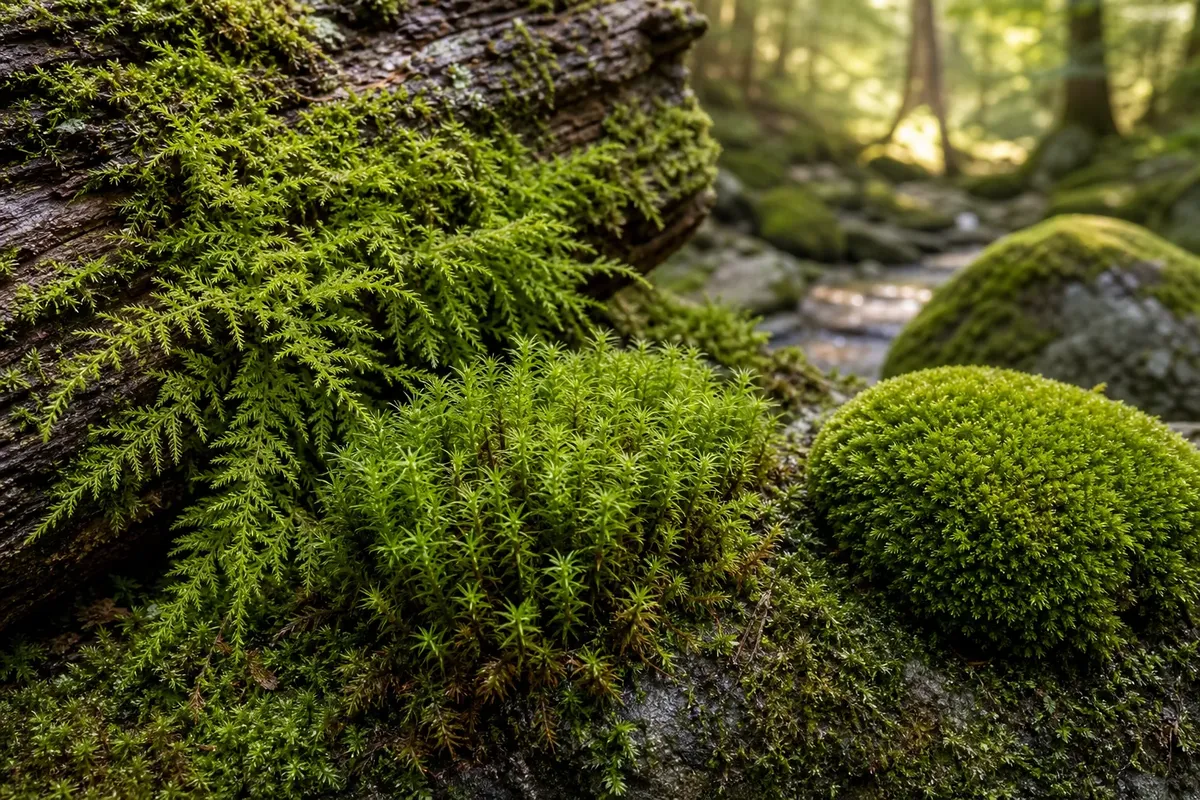
Moss growth forms are useful clues, not names in disguise. A patch that looks leafy, feathery, or cushion-shaped gives you a clear way to describe what is visible, while leaving identification open until you have more clues.
Shape is easiest to read when you look at the patch from two distances: first as a whole, then close enough to see individual shoots. A simple routine over a week can help you build that habit without picking or disturbing the moss.
What can you notice on the first day?
Start with the patch’s outline and its relationship to the surface. Is it a low, even carpet, a cluster of upright tufts, or a set of branching strands? Note whether the growth is on soil, stone, bark, or another surface. These observations describe its form and setting; they do not settle its identity.
Use plain words before specialized ones. “Loose green mat on shaded stone” is more informative than “moss,” and less presumptuous than a species name chosen from a distant glance. If the patch has more than one texture, record that rather than forcing it into one category.
On the first day, write down what the patch looks like before deciding what it resembles.
How does a leafy moss look up close?
Leafy mosses are made of small shoots bearing many tiny leaves. At close range, a shoot can look like a slender stem with leaves arranged around it. Across a patch, numerous shoots may form a mat, tuft, or loose cushion, so “leafy” describes the shoot structure rather than one overall outline.
A hand lens helps reveal the individual shoots and leaves. Look for the way the leaves sit along the stem, their general shape, and whether the shoots stand upright or lie close to the surface. Avoid relying on color alone: light, moisture, and the condition of the patch can all affect how green or dull it appears.
For a field note, try “upright leafy shoots in a dense tuft” or “slender leafy shoots forming a flat mat.” Both phrases communicate more than “green patch” without claiming a species-level identification.
What makes a moss look feathery?
A feathery appearance often comes from branching shoots arranged in a spreading pattern. The main shoot and its side branches can create a plume-like or fern-like outline, especially when the growth lies over bark, soil, or rock. The resemblance is visual, not botanical: moss branches are not fern fronds.
Check whether the branching repeats along the shoot and whether the patch spreads outward as a loose, interwoven layer. A feathery mat may still be composed of leafy shoots; the difference is that branching dominates the view at patch scale.
Say you see a soft-looking green layer on a shaded log, with narrow sprays extending from a central area. You could note “branching, feathery mat on decaying wood,” then revisit the patch after several days to see whether dampness changes its outline or color. The expected observable result is a more useful record of how the same growth looks under different conditions, not a confirmed name.
When is a moss best described as cushioned?
A cushion is a compact, raised mass with a rounded or mound-like profile. Its surface may be made of many crowded shoots, often appearing densely packed from a short distance. Cushions can occur on soil, rock, or other stable surfaces, and their outline may range from tidy domes to uneven hummocks.
Compare the sides and top rather than judging only from above. A cushion has visible depth; a flat mat spreads more evenly across the surface. From close up, a cushion may still contain leafy shoots, so the terms describe different scales: “leafy” can describe the shoots, while “cushioned” describes the patch.
Record the profile and density separately: “rounded, dense cushion with short upright shoots” is more precise than choosing between “leafy” and “cushion.”
How can you compare the forms over a week?
Return to the same patch at several points during the week, if conditions allow. Keep the viewpoint similar, and note whether the moss looks flattened, lifted, or more clearly branched. Changes in moisture can alter the appearance of a patch, so a description made on one visit may not capture its usual form.
Use a small notebook or a phone photo for the record, but include words as well as an image. A photograph may preserve color and outline while hiding the structure of individual shoots. A hand lens is useful when the patch is accessible and you can examine it without pulling at the growth.
- First visit: Record the surface, patch outline, and whether it is flat, raised, or spreading.
- Next visit: Look closely for leafy shoots, branching patterns, or tightly crowded growth.
- After a change in weather: Note any visible shift in color, posture, or apparent density.
- Final visit: Write one short description that combines patch form, shoot structure, and setting.
Which moss shape questions come up in the field?
Can one moss have more than one growth form?
Yes. Shoot structure and patch outline describe different features, and one may be leafy while the whole patch appears feathery or cushioned. Use both terms when they fit instead of treating them as competing labels.
Does a cushion shape identify a particular moss?
No. A rounded, dense profile is a useful description, but different mosses can produce similar-looking cushions. Identification needs additional visible characters and, where appropriate, a reliable field guide or expert review.
Why does a moss patch look different when it is damp?
Moisture can change how shoots sit and how their color appears, making a patch seem fuller or more vivid. Record the conditions alongside the observation rather than treating one appearance as the only form.
Is “feathery” a formal moss group?
It is a descriptive word for a branching appearance, not a taxonomic category. It helps another observer picture the patch but does not, by itself, identify the moss.
What should your final description include?
For a useful field note, combine three things: the overall patch profile, the visible structure of the shoots, and the surface where the moss grows. “Low feathery mat with branching shoots on shaded bark” gives a reader a workable picture. If you are unsure whether a detail is clear, describe what you can see rather than upgrading it into a firm identification.
The leafy, feathery, and cushioned forms of moss make a practical vocabulary for observation. Keep the terms tied to visible features, and your notes will remain accurate even when the name still needs checking.